Our Genomics lab focuses on unraveling the hierarchical layers of regulation that modulate differential disease severity and clinical outcomes during the host-pathogen interactions. By examining the dynamic interactome, which includes 1) Pathogen genome and epigenome. 2) Host response including coding, non-coding, alternative splicing, RNA editing, and epitranscriptomics. 3) Transcriptionally active microbes (TAMs) and AMR.
We aim to identify patient sub-groups susceptible to severe disease. Our research lies at the intersection of Integrative Genomics, Single Cell Transcriptomics, Antibody-seq and Immuno-genomics, to predict and manage future disease severity more effectively. Our lab is currently focused on several key areas in infectious disease biology, including SARS-CoV-2, Dengue virus, Mycobacterium tuberculosis (MTb), AMR, and neonatal sepsis.
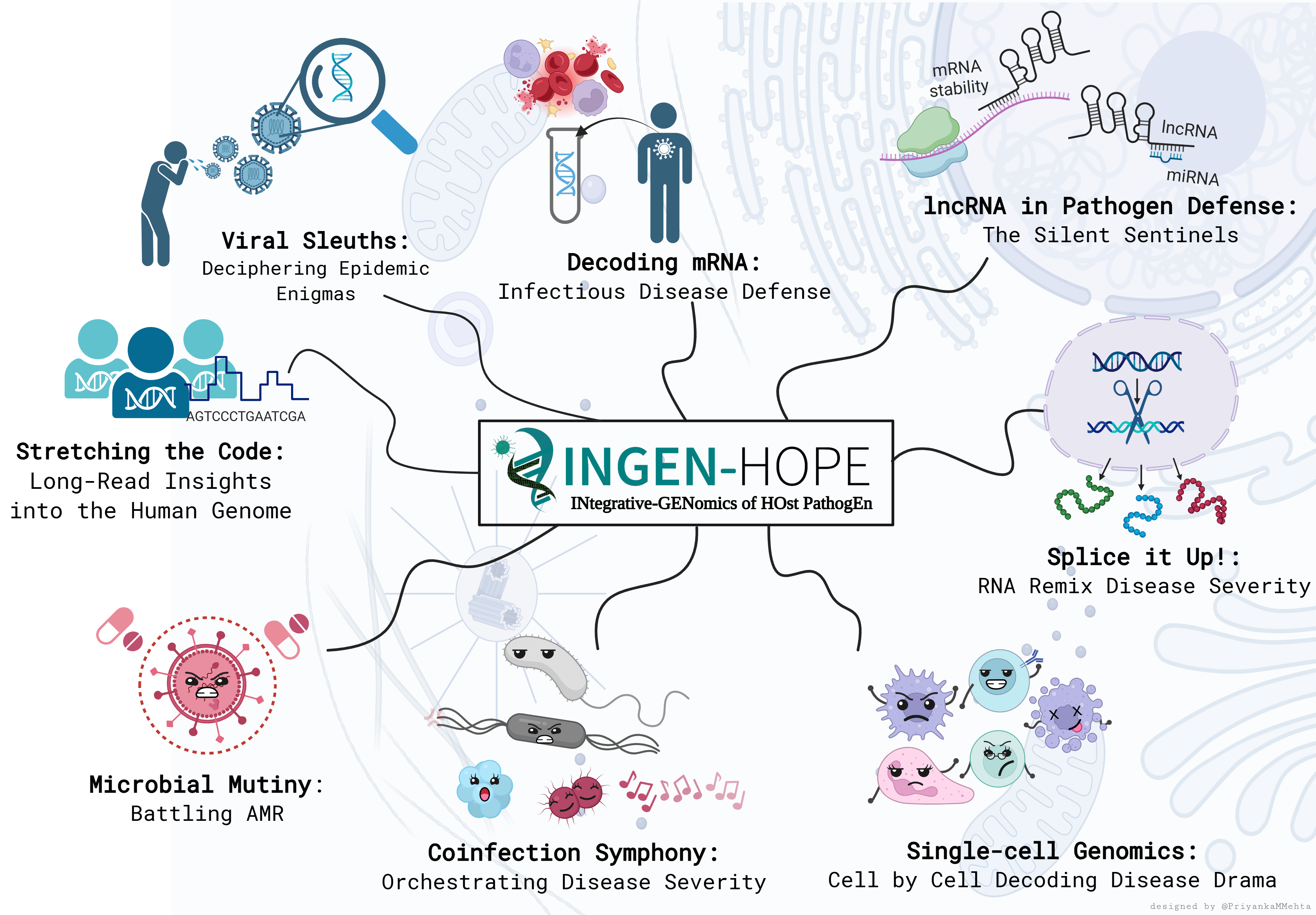
The intricate biological processes underlying development, physiological homeostasis, disease, and infection outcomes are shaped by the diversity of cell states, fates, and types. Combining single-cell multi-omics (whole transcriptome analysis and antibody-seq) with machine learning-based analysis aims to enhance understanding of cellular and immunological heterogeneity in COVID-19 disease severity.(iScience).
Viral epitranscriptomics during infection involves the dynamic alteration of RNA modifications, such as N6-methyladenosine (m6A), adenine and cytosine deamination, in the viral genome to regulate various stages of the viral life cycle, including replication, latency, and reactivation. These modifications are crucial for modulating viral gene expression, host-virus interactions, and evasion of host antiviral responses, emphasizing the need to investigate the intricate relationship between epitranscriptomic modifications, viral infections & disease severities. (iScience).
Mammalian chromosomes are highly compressed, creating 3D genomic architectures. During infections, significant alterations in host genome architecture occur, impacting gene expression & disease outcomes. Research has shown that SARS-CoV-2 infection leads to widespread restructuring of the 3D genome, including compartmental weakening, reduced intra-TAD contacts, and decreased euchromatin modification. This restructuring involves the depletion of the cohesin complex from intra-TAD regions, disrupting cohesin loop extrusion. Understanding these alterations in genome architecture is crucial for elucidating pathogenesis & developing potential therapeutic strategies. (Frontiers in Immunology).
Antimicrobial resistance (AMR) poses a significant threat to global public health, as it renders standard treatments ineffective and leads to persistent infections. Genomics-driven investigations into AMR leverage advanced sequencing technologies to uncover the genetic basis of resistance, track its evolution and spread, and identify novel therapeutic targets. Our lab has shown that TAMs underlie disease severities. We want to understand further: i) Are differential expression of bacterial genes “encoded” in their sensitivity to AMR? ii) Does that impact disease severity & outcome? iii) Can that be used for antibiotic usage choice during treatment? (PLoS Pathogens).
Read More